Brokerage models are not binary. Modern brokers frequently combine elements of multiple execution paradigms—market making, STP routing, ECN matching and DMA—to create hybrid offerings that attempt to optimise liquidity, risk management and commercial return. Traders encounter hybrid brokers across retail and institutional channels. For the informed trader the question is not whether a broker is “hybrid” but which hybrid behaviours it exhibits, how those behaviours change execution economics, and what operational controls are necessary to extract value without exposing capital to unnoticed risks.
This article dissects hybrid broker design and operation in practical terms. It explains common hybrid architectures, how execution and hedging are implemented, the benefits that motivate brokers to mix models, and the drawbacks and failure modes traders must monitor. The aim is to provide a technical reference for evaluating hybrid brokers and for designing monitoring and contingency procedures that preserve execution quality and minimise counterparty exposure.
This article will not help you find a hybrid broker. If you want to find a hybrid broker then i recommend you visit Broker Listings. Broker listings make it very easy to find the type of broker you want and they make it very easy to compare different brokers against each other.
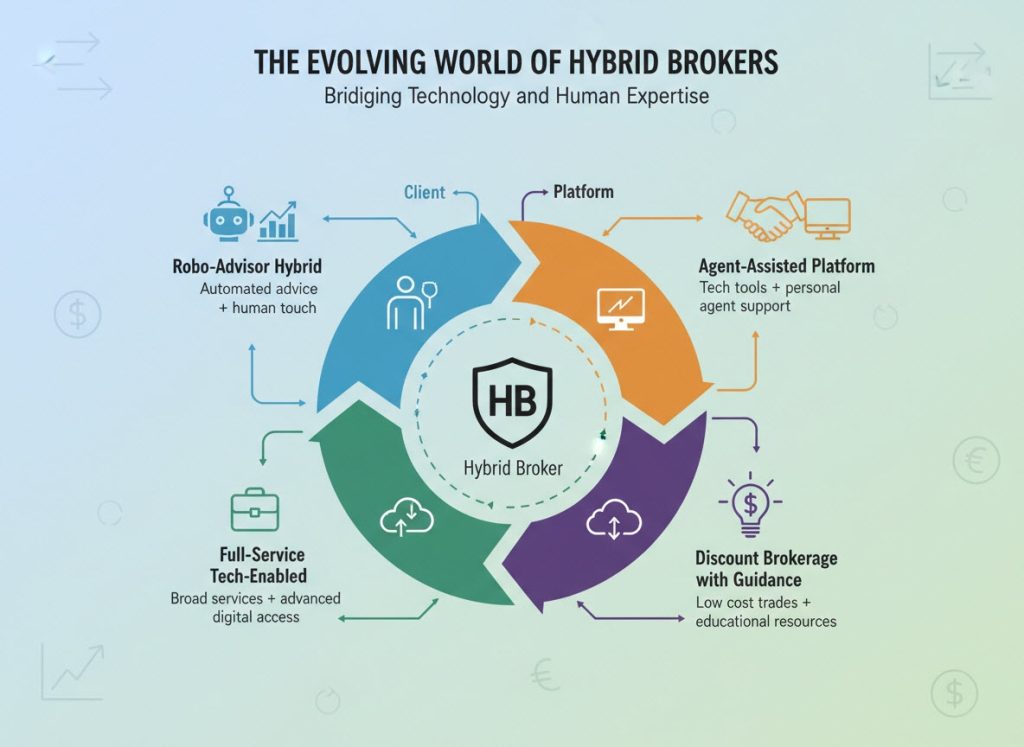
Definition and rationale for hybrid brokers
A hybrid broker intentionally combines two or more execution models within a single offering. The combination may be structural—different product lines routed by different mechanisms—or dynamic—routing mode switches based on market conditions, ticket size, or pricing. The most common components that are blended are market-making (dealer desk), straight-through processing to external liquidity providers, ECN-style matching pools, and DMA to exchange or primary venue order books.
There are commercial and operational reasons for hybrids. From the broker’s perspective, internalizing certain flows reduces execution cost and preserves spread revenue; routing other flows externally limits inventory risk and optimises hedging costs.
Hybrid models give brokers flexibility. Brokers can handle small retail trades in-house for speed and simplicity, while routing larger or institutional orders to ECNs or exchanges where there’s more liquidity. This approach helps them control risk and costs, and lets them serve a mix of clients without needing separate setups for each group. It’s all about getting the right mix of fast execution, market depth, and efficiency in one place.
So, when you see a broker call itself “hybrid,” think of it as a description of how they operate—not a promise of best execution. Some hybrids will send most trades to outside venues but switch to handling them in-house when markets get choppy or for smaller trades. Others might only give direct market access (DMA) to big institutional clients.
The real questions to ask are: what actually makes them switch modes, do they tell you how your trades are routed and hedged, and can they show you detailed trade data to back up their claims? That’s how you separate marketing talk from real transparency.
Architectures and common hybrid variants
Hybrid broker designs coalesce into a few repeatable patterns.
One variant is the segmented model. The broker runs parallel execution channels: an internal market-making desk for retail-sized marketable orders and a separate agency routing engine that sends larger or institutional orders to ECNs or exchanges. Segmentation is often explicit in account types or trading interfaces; a retail web platform routes to the dealer desk while a professional account uses DMA/ECN connectivity.
A second variant is the waterfall model. Here the broker maintains a prioritized routing list: try internal match first, then route to preferred external liquidity providers, then fall back to market makers or a sponsored liquidity pool. The waterfall may be adaptive—reordering providers based on live quotes, rebates, latency or credit availability.
A third variant is conditional mode switching. The broker normally routes flow externally to maintain regulatory optics of agency execution, but during periods of extreme volatility, thin liquidity, or when counterparties withdraw, it preserves continuity by internalizing flow. Conditional switching can be automatic at the system level or manual at trader discretion.
A fourth architecture is affiliate-first routing. The broker routes to affiliated liquidity providers or market-making arms before accessing third-party pools. This improves commercial returns for the firm but introduces conflict-of-interest if routing choices prioritise affiliates over best execution.
A final pattern is the platform hybrid where the broker offers optional services: pure DMA accounts for institutional clients, ECN pools for mid-sized traders, and market-maker fill options for retail. This model provides a menu of trade-offs but requires clear account design and pricing transparency.
These architectures are not mutually exclusive. Practical implementations mix segmentation with waterfalls and conditional switching to manage capital, regulatory exposure and client expectations. For traders the critical evaluation is to map claims to behaviours and to obtain observable execution evidence.
Execution mechanics and the routing waterfall
Execution in a hybrid broker is governed by a waterfall: the ordered sequence of liquidity sources and match engines the broker consults for a given order. The waterfall integrates internal matching pools, affiliated market makers, external ECNs, prime bank feeds, and exchange endpoints. The router evaluates price, available size, latency, fees, and contractual restrictions in selecting the execution path.
Order types interact with the waterfall. Market orders frequently seek immediacy and are more likely to be filled by a dealer desk if internal liquidity exists; limit orders are often posted to external books or internal limit pools depending on the broker’s policy and fee incentives. Smart routers in hybrid setups may slice large orders, post residuals across venues, or attempt midpoint matches when available. Execution determinism varies across elements of the waterfall: ECNs typically enforce price-time priority; dealer desks exercise discretion.
Hedging is a second, linked activity. Brokers that internalize flow may hedge principal risk in the interdealer market or at exchanges. The timing and method of hedging—pre-trade hedge, post-trade immediate hedge, or periodic netting—determine hedge slippage and residual exposure to the broker’s balance sheet.
In hybrid setups, how trades are hedged depends on where they’re sent. If your trade goes to an outside venue, that provider usually handles the hedge right away. If the broker keeps your trade in-house, they’re the one managing the risk.
Timing matters too—brokers might bundle up a bunch of client trades before hedging, which can save on costs, but it also means they’re exposed to market moves for a bit before the hedge goes on. It’s all about balancing efficiency and risk.
Fee structures interact with routing. Some hybrid brokers separate commission from spread for routed trades while embedding a spread markup for internalized trades. Maker-taker or rebate schemes may apply selectively across venues and may be retained or partially passed through by the broker. These economics drive routing incentives and must be understood to evaluate net cost.
Transparency about the waterfall and hedging policy is often partial. Brokers may publish high-level routing policies but not the full waterfall or the conditions that trigger internalization. Traders therefore need to demand per-trade venue identifiers, timestamps and hedge execution logs to reconstruct the true execution path and quantify hedge slippage.
Benefits: when hybrids make sense
Hybrid brokers offer genuine advantages in multiple scenarios.
Continuity and liquidity resiliency is a prime benefit. By combining internal liquidity with external sources, hybrids can provide fills during short-lived liquidity shocks when external providers pull back. That continuity is valuable for retail platforms that must process thousands of small trades instantly and cannot afford frequent re-quotes or platform freezes.
Commercial optimisation is another advantage. Hybrids allow brokers to use balance-sheet capital to capture spread revenue on predictable small-ticket flows while routing larger or strategic orders to markets where the broker cannot profitably internalize. This can translate to lower explicit commissions for certain account types or better pricing for institutional customers who are routed to ECNs/DMA.
One big advantage of hybrid setups is flexibility. Brokers can offer different service levels to different types of traders, direct market access (DMA) for pros, ECN routes for heavy hitters, and fast market-maker fills for more casual users, all under one roof. This way, they reach more customers, and you get to pick the setup that best matches your trading style, without the broker having to run separate businesses for each group.
Operational efficiency is material for the broker. Aggregating net client flow and hedging strategically lowers total hedging costs. For example, netting offsets across many clients reduces turnover in the interdealer market relative to hedging each ticket separately, lowering costs that can be shared with clients via tighter net pricing.
Finally, hybrids can combine the best of deterministic matching and discretionary liquidity. When implemented with robust disclosure and controls, hybrids let sophisticated traders access venue-level depth while giving smaller clients predictable, immediate execution.
Drawbacks and operational risks
Hybrids also introduce significant risks and drawbacks that traders must acknowledge.
Opacity is the central concern. When a broker toggles between modes or routes asymmetrically across clients, it can be hard to determine whether fills resulted from competitive external liquidity or from internalisation. Without per-trade venue IDs and hedge logs, TCA cannot partition costs and exposures into market impact, hedge slippage and potential adverse routing.
Conflicts of interest are more likely. Brokers that keep affiliated market makers or accept referral fees may have an incentive to route to those parties even if price is inferior. Conditional internalization during stress may benefit the broker’s balance sheet at the cost of customers’ best execution.
Execution quality can be inconsistent. A hybrid may provide excellent ECN fills for institutional accounts while the same instrument on the retail web platform is subject to market-maker spreads. Dynamic mode switching can produce non-linear execution behaviour during liquidity shifts, manifesting as wider spreads, requotes, or partial fills at time-critical moments.
Hedging asymmetry is problematic. If internalized flow is hedged later or at aggregated intervals, the broker bears interim risk that can produce slippage or liquidity shortfalls if market moves rapidly. Worse, failure in the broker’s hedging operations—connectivity to hedge counterparties, clearing-sponsor limits, or insufficient capital—can introduce systemic risk to clients.
Regulatory and contractual complexity increases. Hybrids often span multiple jurisdictions, clearing arrangements and affiliate structures. In stressed scenarios, the legal path for dispute resolution or recovery of funds may be unclear. Contract clauses that allow the broker to change routing or widen spreads under “volatile market conditions” can be activated at precisely the time when clients need predictable execution.
Finally, monitoring and operational overhead for the client increases. Traders must implement more sophisticated TCA and operational checks to ensure the broker behaves as claimed. That imposes cost and expertise requirements that small traders may find prohibitive.
Due diligence and selection criteria for traders
Effective due diligence focuses on observable behaviours and contractual clarity rather than marketing labels.
Obtain the execution waterfall and routing policy in writing. The waterfall should list primary liquidity sources, affiliates, and conditions that trigger fallback to internalization. If the broker resists providing this, treat the claim of hybrid routing skeptically.
Request per-trade execution reports with venue identifiers, client-order and execution timestamps, executed size and any listed hedge trades with timestamps. Validate that venue IDs map to genuine external venues or exchange order books. Compute effective spread and implementation shortfall segmented by instrument, size and time of day.
Clarify hedging mechanics. Ask whether hedges occur per trade, at end-of-day, or via periodic netting. Obtain examples showing a client fill with the corresponding hedge execution to measure hedge slippage. Confirm whether hedges are executed via third-party clearing members and whether client funds are segregated.
Examine fee treatment across modes. Determine whether commissions, rebates and spread markups differ by account tier and routing mode. Ask whether maker rebates are retained, partially passed on, or fully passed on to the client, and request example economics for typical trades.
Check how reliable a broker really is. Ask for their uptime stats, any reports on past outages or major hiccups, and details on risk controls before trades go through—like limits on order sizes or how many messages you can send. If you’re using algorithms, find out if there are limits on API messages, what the allowed order-to-trade ratios are, and whether those restrictions change depending on your account level.
Regulatory posture matters. Confirm licensing, jurisdiction of custody, and whether the broker’s affiliate entities create legal complexity. Review contractual clauses that allow unilateral changes to pricing or routing during “volatile market conditions” and negotiate restrictions where possible.
Finally, pilot and measure. Run a phased test program with varying sizes, instruments and times. Analyse TCA results and hedge linkages, and escalate issues. If execution or transparency does not meet expectations, have exit clauses ready.
This article was last updated on: February 10, 2026